Showing posts with label economics. Show all posts

Monday, October 04, 2010

"Once the game is over, the King and the Pawn go back in the same box." - Italian Proverb


Welch began by stating that "all of economics results from inequality. Without inequality of priorities and capabilities, there would be no trade, no specialization, and no surpluses produced by cooperation." He invited his audience to consider a world in which skill, effort, and sheer chance played no role whatsoever in what you got paid. The only decision that would affect your wage level would be when to leave school. "After that, the clock ticks, and wages follow the experience path. Nothing else matters. Can you imagine a more horrible, a more deadening existence?"
But something close to the dystopia Welch envisioned already exists for those toiling in the economy's lower tiers. Welch should have a chat with his office receptionist. Or he could read Nickel and Dimed, or the 2010 book Catching Out by Dick J. Reavis, a contributing editor at Texas Monthly who went undercover as a day laborer. Waitresses, construction workers, dental assistants, call-center operators—people in these jobs are essentially replaceable, and usually have bosses who don't distinguish between individual initiative and insubordination. Even experience is of limited value, because it's often accompanied by diminishing physical vigor.
Welch said that he believed inequality was destructive only when "the low-wage citizenry views society as unfair, when it views effort as not worthwhile, when upward mobility is impossible or so unlikely that its pursuit is not worthwhile." Colleen's comment would appear to suggest that the first of these conditions has not been met. But that's only because I omitted what she went on to say: "But what I would like is to be able to take a day off now and then … if I had to … and still be able to buy groceries the next day." Colleen may not begrudge the rich the material goods they've acquired through skill, effort, and sheer chance, but that doesn't mean she thinks her own labors secure her an adequate level of economic security. Clearly, they don't.

Slate | Why We Can't Ignore Growing Income Inequality

Thursday, December 24, 2009

everybody's gotta learn sometime


Ever-increasing choice was supposed to mean the end of the blockbuster. It has had the opposite effect.

“Perhaps the best explanation of why this might be so was offered in 1963. In “Formal Theories of Mass Behaviour”, William McPhee noted that a disproportionate share of the audience for a hit was made up of people who consumed few products of that type. (Many other studies have since reached the same conclusion.) A lot of the people who read a bestselling novel, for example, do not read much other fiction. By contrast, the audience for an obscure novel is largely composed of people who read a lot. That means the least popular books are judged by people who have the highest standards, while the most popular are judged by people who literally do not know any better. An American who read just one book this year was disproportionately likely to have read “The Lost Symbol”, by Dan Brown. He almost certainly liked it.”

The Economist | A World of Hits

Thursday, September 24, 2009

"You don’t understand the basic assumptions of your own culture if your own culture is the only culture you know." - Alan Watts


After prayer, we ate dinner. The food was catered from one of my favorite greasy restaurants, Kennedy Fried Chicken. It’s a huge halal food chain here in New York. It’s halal and open late, can’t go wrong with it. Tonight I had a philly cheesesteak, cheesy tater tots and an orange (to give my meal an ounce of healthiness). Epic yum.

30 Mosques, 30 Days

Dubai tends toward gluttony every month of the year, but during Ramadan, things are even more over the top, with nearly every eating establishment offering an Iftar fast-breaking gut-buster at sundown. It's Dubai doing what it does best: using its limited resources for its own commercial advantage. Even American fast-food outlets in Dubai offer Ramadan Value Meals, usually adding a dessert to the already calorie-packed meal deal. At the Dubai Mall, McDonald's was the only major international food chain that didn't have a special offer, just a banner that read: "Ramadan Kareem"--"Happy Ramadan."

Slate | My Ramadan World Tour

Thursday, September 10, 2009

our home is our rocket ship


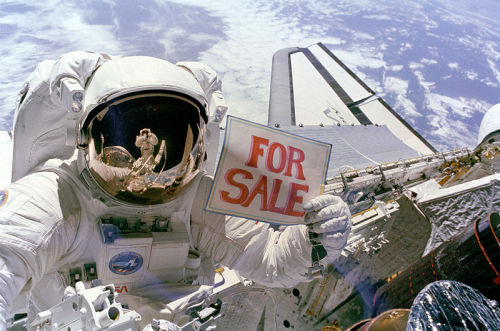
Astronaut Dale A. Gardner, holds up a “For Sale” sign refering to the two satellites, Palapa B-2 and Westar 6 that he retrieved from orbit after their Payload Assist Modules (PAM) failed to fire.

Flickr | Review of U.S. Human Space Flight Plans Committee

Monday, August 31, 2009

oh i understand, oh i understand. now i understand.

In reaction to my post yesterday, several people pointed out that Obama's budget deficits would lead to certain economic doom. Let's take a look at that assumption.

First, if you are American, and you believe the deficit means certain doom, you should cash in all of your investments and move into some sort of survivalist encampment, or to a country that has less of a budget problem. You don't want to pay your share of the $19 trillion. So if you aren't already packing to leave, maybe you are just saying you think the ballooning national debt is the end of us all, but you really think we'll figure a way out of it. This might be similar to saying you believe in Jesus but for some reason you refuse to give most of your money to the needy. There's a difference between real believing and whatever the heck the other thing is.

Scott Adams Blog | The Budget Deficit

Monday, August 17, 2009

"That which you call "the external world" is as much you as your own body." - Alan Watts

Nine years ago, in the autumn of 2000, Suelo decided to stop using money. He just quit it, like a bad drug habit. His dwelling, hidden high in a canyon lined with waterfalls, is an hour by foot from the desert town of Moab, Utah, where people who know him are of two minds: He’s either a latter-day prophet or an irredeemable hobo. [...]

The tribe had been getting richer for a decade, and during the two years he was there he watched as the villagers began to adopt the economics of modernity. They sold the food from their fields — quinoa, potatoes, corn, lentils — for cash, which they used to purchase things they didn’t need, as Suelo describes it.

They bought soda and white flour and refined sugar and noodles and big bags of MSG to flavor the starchy meals. They bought TVs. The more they spent, says Suelo, the more their health declined. He could measure the deterioration on his charts. “It looked,” he says, “like money was impoverishing them.”

Men.Style.com | Could You Survive Without Money?

Friday, August 07, 2009

"I spend an enormous amount of money protecting myself against evil." - Bill O'Rielly


This entry records a country's net trade in goods and services, plus net earnings from rents, interest, profits, and dividends, and net transfer payments (such as pension funds and worker remittances) to and from the rest of the world during the period specified. These figures are calculated on an exchange rate basis, i.e., not in purchasing power parity (PPP) terms.

Central Intelligence Agency | The World Factbook
Photo by Norman Parkinson, American Vogue November 1956

Wednesday, August 05, 2009

Tuesday, August 04, 2009

Monday, August 03, 2009

i keep waiting for earthquakes

Chuck The Goal Of Economic Growth Out the Window
Beyond a certain point, GNP doesn’t really correspond with human satisfaction and the idea that a economy can grow forever is probably just dump. To illustrate: Under present rules, the jackass who takes high speed joyrides in his Hummer is a more valuable economic citizen than the person who commutes to work on a bike (all else being equal).

The Infrastructurist | 20 Bold Schemes That Could Save The World

Tuesday, July 21, 2009

I coulda been a contender. I coulda been somebody.

Promoting the people most competent at one job does not mean that they’ll be better at another, according to a new simulation of hierarchical organizations.
There’s a paradox at the heart of most Western organizations. The people who perform best at one level of an organization tend to be promoted on the premise that they will also be competent at another level within the organization. I imagine that most readers will have had personal experience at the way that this hypothesis fails in practice.

In 1969, a Canadian psychologist named Laurence Peter encapsulated this behavior in a rule that has since become known as Peter’s Principle. Here it is: “All new members in a hierarchical organization climb the hierarchy until they reach their level of maximum incompetence.”

That’s not as unfair as it sounds, say Alessandro Pluchino and buddies from Universita di Catania, who have modeled this behavior using an agent-based system for the first time. They say that common sense tells us that a member who is competent at a given level will also be competent at a higher level of the hierarchy. So it may well seem a good idea to promote such an individual to the next level.[...]

Now Pluchino and co have simulated this practice with an agent-based model for the first time. Sure enough, they find that it leads to a significant reduction in the efficiency of an organization, as incompetency spreads through it. That must have an uncomfortable ring of truth for some CEOs.

MIT Technology Review| The Physics arXiv Blog | Why Incompetence Spreads through Big Organizations

Monday, July 20, 2009

Clear American Sky A Constant Reminder Of Industrial Inferiority


Well, I've sold the paper to the Chinese.
As the longtime publisher of this news-paper, it is my duty and unrestrained pleasure to announce to you spittle-soaked readers that I have sold The Onion and all of its various holdings to a syndicate of industrious China-men from the deepest heart of the Orient.
The Onion | The Onion sells out to China

Yu Wan Mei offers a humbling variety of specialty products for every conceivable use and manner of consumption. It is true, sensible and levelheaded customers cannot resist the safety and reliability of our full range of quality goods and foodstuffs.
Yu Wan Mei | Amalgamated Salvage Fisheries And Polymer Injection Corporation, New Owner of The Onion

Sunday, June 14, 2009

i am a consumer whore


Business model innovation is often self-defeating and self-destructive. The real problem with business model innovation is that it dilutes the incentives to make good stuff in the first place.

Business model innovation creates a kind of adverse selection. It offers a kind of insurance: if we can find more efficient ways to sell stuff, we don’t have to make better stuff. When we invest in selling stuff better — instead of making better stuff — unsurprisingly, the stuff we make often turns into lemons.

The 90s and 00s have been full of companies churning out the same old lame, toxic junk and trying to sell it in new ways — instead of detoxifying it.

Harvard Business Publishing | The Best Business Model in the World
Quote: Don Hertzfeldt's "Rejected"

The Japanese dies if there is no rice


Tumblr | Hospital Food

Tuesday, June 09, 2009

"Our task must be to free ourselves...by widening our circle of compassion to embrace all living creatures and the whole of nature and its beauty."


What do these crises have in common:

Economic crisis
Water shortages
Global warming
Healthcare
Energy

Okay, they probably have lots of things in common. But the answer I was looking for is "food."

Imagine for a minute that everyone in the United States stopped overeating and became vegetarians, perhaps with some fish thrown in the mix for protein and Omega-3. We all know that situation can never happen, so this is just a thought experiment...

Read more: The Common Crisis | Dilbert.com Blog
Quote: Albert Einstein

Friday, June 05, 2009

You could save all of this money by using the public library.


Bucky's Animal Spirit is a public intervention disguised as an ATM Machine installed surreptitiously in a downtown office building... next to an actual ATM.
I installed this video game in a Troy, NY downtown office building on May 1st 2009 hoping people would think it was an actual ATM machine. I was quite pleased to see they did not want to punch my face off when they realized it was not an ATM at all, but an arcade game where they help "Bucky the Beaver" save money in the Shitty Economy.
Bucky's Animal Spirit

Sunday, May 03, 2009

"Go confidently in the direction of your dreams. Live the life you have imagined." - Henry David Thoreau


Wal-Mart has been found to violate the National Labor Relations Act in the past. In a 2008 case, which pertained to events in 2000-2002, the NLRB found that Wal-Mart illegally fired an Arizona employee because of his support for unionization and ordered him reinstated with back pay.

The board also ordered the company to post notices in the workplace informing employees they have a legal right to support the union if they desire.

In 2007, the board ordered Wal-Mart to take back disciplinary action imposed on a worker charged with distributing union materials on work time.

Even if a local union wins an election, companies have sometimes succeeded in dragging out talks for years.

''With an employer like Wal-Mart, it's almost axiomatic that will automatically happen,'' said Bruce Nissen, a Florida International University labor sociologist who has written extensively about unions.

Wal-Mart, the world's largest retailer, said its workers don't want to unionize.

''Looking at all we offer, many of our associates just don't seem to feel that union membership would be a better deal,'' company spokeswoman Daphne Moore said.

North Miami Beach Walmart May Be First to Unionize
Image | Colodio on Flickr

Tuesday, November 25, 2008

Sunday, November 16, 2008