Showing posts with label money. Show all posts

Wednesday, March 31, 2010

actually why don't you just stay home and watch the history channel


Reporting from San Francisco - The University of California on Tuesday began considering dramatic changes in the way it educates its students and raises revenue, including whether to offer three-year bachelor's degrees and enroll more out-of-state undergraduates.

UC's Commission on the Future heard its first set of proposals aimed at making the 10-campus system more efficient while preserving its academic strengths. Some ideas are sure to be controversial as they are discussed over the next few months, officials said.

"Some recommendations you may like a lot. Some you may think are terrible. But that's OK. They are important ideas to put forward," UC Regents Chairman Russell S. Gould said at the commission's meeting at UC San Francisco.

Proposals from the commission's five subcommittees include: encouraging some students to complete bachelor's degrees in three years through extra summer sessions and fewer requirements; doubling the number of out-of-state students, who now make up 5% of undergraduates and pay significantly higher fees; charging more for the most popular campuses, including UC Berkeley and UCLA; and expanding online course offerings.

LA Times | UC panel proposes three-year bachelor's degrees, other big changes

Problem: Fees are too high at the University of California for all students to afford an education there. Executive bonuses and construction projects continue to rise, as workers and staff are laid off.
Solution: Encourage students to take on a heavier course load and rush through school, ditch the classrooms and put classes online, reject more Californian students from the UC applicant pool.

Something's not right here.

Monday, November 30, 2009

come on, kitty-kitty-kitty

If the goal is to earn a living, then, maybe it isn’t really true that 18-year-olds need to be imparted with a sense of panic about getting into college (though they certainly need to learn). Some people are hustled off to college, then to the cubicle, against their own inclinations and natural bents, when they would rather be learning to build things or fix things. One shop teacher suggested to me that “in schools, we create artificial learning environments for our children that they know to be contrived and undeserving of their full attention and engagement. Without the opportunity to learn through the hands, the world remains abstract and distant, and the passions for learning will not be engaged.”

A gifted young person who chooses to become a mechanic rather than to accumulate academic credentials is viewed as eccentric, if not self-destructive. There is a pervasive anxiety among parents that there is only one track to success for their children. It runs through a series of gates controlled by prestigious institutions. Further, there is wide use of drugs to medicate boys, especially, against their natural tendency toward action, the better to “keep things on track.” I taught briefly in a public high school and would have loved to have set up a Ritalin fogger in my classroom. It is a rare person, male or female, who is naturally inclined to sit still for 17 years in school, and then indefinitely at work.

New York TImes | The Case for Working with Your Hands

Wednesday, November 18, 2009

Updates on UC Regents protests today and tomorrow

The protests at the Regents' meeting have escalated to skirmishes between students and police. At least 14 arrests have already been made inside the meeting, before noon. Students keep disrupting the meeting, and the police have just announced that the entire gallery (public seating) is an "unlawful assembly." Students have been fighting with police outside, with unconfirmed rumors that students are throwing rocks at police; police have tased one student and clubbed several more. One student broke their leg, though it is not yet known how. Police helicopters are overhead, police have donned riot gear, and have threatened to use tear gas on campus. Lynn Tierney, spokesperson for UCOP, has denied that any students were tased, although this has been confirmed by legal observers. About 500 protesters outside, talk of encircling the building if students aren't allowed into Covel Commons. Police have drawn pellet guns on students and ordered them to disperse. 15-20 students remained and have possibly been arrested. Students are being forced away from Covel by police, where the meeting is taking place.

Yudof had the audacity to post on twitter: "Protesters' problems not with me or Regents, but with Sacramento and even voters."

The Afrikan Student Union at UCLA reported that at least 3 members were tased by police.

Updates at UC Regent Live
Updates at Student Activism
UC Regents Protest Schedule
LA Times | Eight arrested at UC Regents meeting at UCLA
Photos and more LIVE updates at The Daily Bruin

Sunday, September 06, 2009

is it much to admit i need a solid soul and the blood i bleed

Why don't things make us happy? The answer, I think, has to do with a fundamental feature of neurons: habituation. When sensory cells are exposed to the same stimulus over and over again, they quickly get bored and stop firing. (That, for instance, is why you don't feel your underwear.) This makes sense: the brain is an efficient organ, most interested in the novel and new. If we paid attention to everything, we'd quickly be overwhelmed by the intensity of reality. Unfortunately, the same logic applies to material objects. When you buy a shiny new Rolex watch, that watch might make you happy for a few days, or maybe even a week. Before long, however, that expensive piece of jewelery becomes just another shiny metal object - your pleasure neurons have habituated to the luxury good. (Of course, your Rolex can become a problem for everybody else, since it raises the material expectations of all those poor souls wearing less expensive watches. These people now feel inferior, since their Timex has been devalued by the costlier item. [Such luxury items are known as "positional goods," since part of their appeal is that they signal your social position.] Multiply this same psychological phenomenon across a full range of consumer products - from clothes to cars, stereos to shoes - and you can begin to see the "hedonic treadmill" that afflicts people in developed countries. Not only do their brain cells automatically adapt to their state of wealth, but those same neurons are constantly being bombarded with a new set of expensive expectations. Of course, not everybody can afford a Rolex or a Lexus, which means that we are constantly being disappointed.)

The Frontal Cortex | Money and Happiness

Monday, August 17, 2009

"That which you call "the external world" is as much you as your own body." - Alan Watts

Nine years ago, in the autumn of 2000, Suelo decided to stop using money. He just quit it, like a bad drug habit. His dwelling, hidden high in a canyon lined with waterfalls, is an hour by foot from the desert town of Moab, Utah, where people who know him are of two minds: He’s either a latter-day prophet or an irredeemable hobo. [...]

The tribe had been getting richer for a decade, and during the two years he was there he watched as the villagers began to adopt the economics of modernity. They sold the food from their fields — quinoa, potatoes, corn, lentils — for cash, which they used to purchase things they didn’t need, as Suelo describes it.

They bought soda and white flour and refined sugar and noodles and big bags of MSG to flavor the starchy meals. They bought TVs. The more they spent, says Suelo, the more their health declined. He could measure the deterioration on his charts. “It looked,” he says, “like money was impoverishing them.”

Men.Style.com | Could You Survive Without Money?

Friday, August 07, 2009

"I spend an enormous amount of money protecting myself against evil." - Bill O'Rielly


This entry records a country's net trade in goods and services, plus net earnings from rents, interest, profits, and dividends, and net transfer payments (such as pension funds and worker remittances) to and from the rest of the world during the period specified. These figures are calculated on an exchange rate basis, i.e., not in purchasing power parity (PPP) terms.

Central Intelligence Agency | The World Factbook
Photo by Norman Parkinson, American Vogue November 1956

Monday, July 20, 2009

All generalizations are false, including this one

A west coast VC is visiting an east coast friend in the Hamptons for the weekend. He drives by a farmer with a horse and offers him $1,000 for the horse. The farmer accepts and agrees to transport the horse to the VC out west. After a few days, the farmer calls the VC and says the horse has died but he can’t refund the money because he’s already spent it. The VC says: “Don’t worry. Deliver me the dead horse.” The farmer, shocked and confused, complies.

A week later the farmer calls the VC, feeling terrible about the money and curious what the VC could possibly do with a dead horse. The VC explains: “Don’t worry. I made $19,990 off your horse.” The farmer stunned asked, “How?!” The VC said, “I advertised a lottery for a horse. At $10 a ticket, I sold 2,000 tickets.” The farmer incredulous demanded, “But wasn’t the winner furious he won a dead horse?” The VC smiled, “Yep—and I gave him back his $10.”
Forbes | Weekly Insider

Tuesday, June 16, 2009

"The government of the United States is not, in any sense, founded on the Christian religion." - John Adams, 2nd president of the United States


Never codified by law, E pluribus unum was considered a de facto motto of the United States until 1956 when the United States Congress passed an act (H.J. Resolution 396), adopting In God We Trust as the official motto. [...]
Originally suggesting that out of many colonies or states emerge a single nation, [E Plurbus Unum] has come to suggest that out of many peoples, races, religions and ancestries has emerged a single people and nation.
Wikipedia | E Plurbus Unum

A law passed by the 84th Congress (P.L. 84-140) and approved by the President on July 30, 1956, the President approved a Joint Resolution of the 84th Congress, declaring IN GOD WE TRUST the national motto of the United States. IN GOD WE TRUST was first used on paper money in 1957, when it appeared on the one-dollar silver certificate. The first paper currency bearing the motto entered circulation on October 1, 1957.
U.S. Treasury | Fact Sheet

The same Congress had required, in the previous year, that the words appear on all currency, as a Cold War measure: "In these days when imperialistic and materialistic Communism seeks to attack and destroy freedom, it is proper" to "remind all of us of this self-evident truth" that "as long as this country trusts in God, it will prevail."
Wikipedia | In God We Trust

Sunday, October 12, 2008

got money and you know it

Gold isn’t the only precious metal, or even the most expensive. That “honor” belongs to rhodium, whose price far exceeds that of its weight in $100 bills. There’s an interesting coincidence in this price range: Cocaine is about $50/gram, while a fifty dollar bill weighs about a gram. Even exchange? Platinum is also in the same price range, so you could say that $50 bills are worth their weight in platinum.
The Monetary Density of Things

Saturday, September 13, 2008

give me ur moneys


Consider another invention, one so deeply embedded in our daily lives that we seldom think of it as an invention at all: money. It was a creation not of an individual but of the free market. And while money was once exclusively a material object, it is today increasingly abstract.

Human beings are, uniquely, trading animals. Trade has allowed both individuals and entire countries to specialize in what they are good at or have in abundance, selling the surplus to acquire what they lacked. Trade allows us to exploit what economists call “comparative advantage.” Because both parties to a transaction value what they receive more than what they trade away, wealth is created. And nothing has facilitated trade more—thus fostering the enrichment of the world—than the invention of money. (…)

Without money, people who want to trade what they have for something else they want must barter with someone with a complementary interest. If a man has apples and wants oranges, he must find a person who has oranges and wants apples. Economists, with their usual talent for turning an unmemorable phrase, call this a “double coincidence of want.”

But barter only works effectively when the number of goods being traded is limited. When humans in Neolithic times abandoned hunting and gathering in favor of agriculture, they settled down in one place for long periods and began developing ever more technologies (including pottery and beer fermentation). As the number of potential trade goods increased rapidly, the burden of finding the “double coincidence of want” increased exponentially, too.

As trade increased, the need for a means of comparing the value of different commodities also grew. (…) Slowly, people began to talk about the value of all goods in terms of one standard good, usually an item of high value.

Thursday, February 28, 2008

take this as a sign

"If you give me $1,626 I will go to the small Okinawan island called Iriomote and send you an envelope filled with star-sand (don't worry, I've been there before, I know where to go). I will send it from there. [...]

"If you give me $30 I will walk around New York, and the first homeless person I see I will buy him or her whatever he or she wants to eat (as long as it is less than $30). I will mail you back the exact change (minus the paypal fee and the cost of the postage stamp) with the receipt for the food and the name of the person who ate it."

David Horvitz: "Things for Sale that I Will Mail You"
image:"FISKUR (fish)," 2004. 15 Polaroids placed in a row close to the floor. Each time someone took a look at the photos at the opening, another picture was shot and hung up beside the others. By Darri Lorenzen.

Monday, February 11, 2008

these few presidents, frowning in my pocket


"WITH markets swinging widely, the Federal Reserve slashing interest rates and the word “recession” on everybody’s lips, renewed attention is being given to the gap between the haves and have-nots in America. Most of this debate, however, is focused on the wrong measurement of financial well-being.

"[...]Looking at a far more direct measure of American families’ economic status — household consumption — indicates that the gap between rich and poor is far less than most assume, and that the abstract, income-based way in which we measure the so-called poverty rate no longer applies to our society."

The top fifth of American households earned an average of $149,963 a year in 2006. The bottom fifth earned just $9,974, but spent nearly twice that — an average of $18,153 a year.


[You Are What You Spend]
title: WHY? lyrics

Thursday, January 31, 2008

just the slight jingle of pocket change pulsing

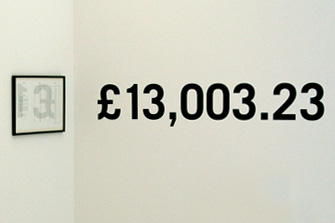
“Inventory” by Carey Young. The artist was weighed on June 27 2007, the date on which this art work was commissioned. In consultation with two scientists, Dr. John Emsley (University of Cambridge) and Dr. Ilya Eigenbrot (Imperial College London), calculations were made as to the mass and current market value of each chemical element present in the artist’s body at the time of weighing. The total market value of these elements (expressed as a graphic on the wall) plus a print of the calculation data constitute the form of this piece. The calculated market value also represents the initial sale price of this piece.

Monday, January 07, 2008

"he that is of the opinion money will do everything may well be suspected of doing anything for money" ––benjamin franklin

a conversation with bill moyers and benjamin barber about how modern short-view hypercapitalism is undermining democracy and societal health. part 1:


[watch part 2 and part 3...]